Friday, May 8, 2015

Summary of 2nd Semester #15

#mathland
This semester was pretty good. However, I am disappointed in myself for my grade, but you were a fantastic teacher. Thank you so much for putting time and effort into my learning. I am really sad that I won't have you next year, and I'm scared of Mrs. Peltier (tbh). You are such an awesome teacher and I have learned so much from you and I enjoyed your class. I, personally, do not have anything bad to say about your class. It was a challenge, but it was a need one. Math is tough, but you made it fun and continue to do what you are doing, because I know students love your class. 
Ps... C is for Confidence!!! 

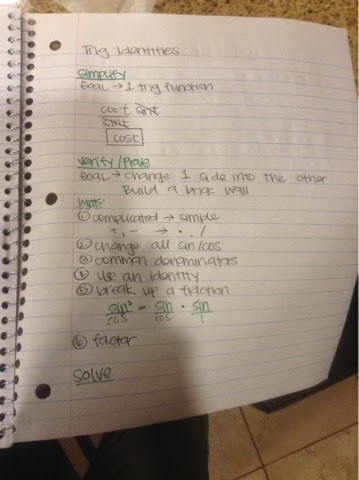
Trig Identities #14

Your goal to simplifying  trig functions is to end with one trig function. To do that, use trig identities, which cancel out some parts of the function. Your goal to verifying is to change one side into the other. One key is to build a brick wall. One hint isto start with the complicated side. Then, change all sines and cosines. Then, find denominators and use an identity. Finally, break up a fraction and factor. To simplify, use the unit circle and have all the same trig functions. Then, factor and DO NOT divide and cancel! 

Tuesday, May 5, 2015

Repeating Decimals #13

Repeating decimals are fun! Every repeating decimal is the sum of an infinite geometric series. The key to finding the answer is to write the decimal all as a quotient of integers. In other words, as a fraction. An example would be...
Given: 0.232323...
First step: write as a geometric series
0.23 + 0.0023 + 0.000023 + 0.00000023 + ...
Second step: find the sum
23/100 + 23/10,000 + 23/1,000,000 + ...
r(the pattern) = 1/100
Use the formula S = a/1-r
S = (23/100)/(1-(1/100)) = (23/100)/(99/100) = 23/99

Parametric Equations #12

The first step to solving a parametric equation is to sketch the graph. Making a table helps. Then eliminate the parameter by using substitution, elimination, and trig identities. When it comes to solving, always eliminate "t." The parameter = t. In every set of equations, an interval is given. A key is to look for a trig identity that only has the sin, cos, or tan in the equation. 

Saturday, May 2, 2015

Partial Fractions #11

There are three set up steps for partial fraction decomposition. 1. Divide if it is improper. 2. Factor he denominator. 3. If it is linear, add A,B,C...etc. If it is quadratic, add Ax+B, Cx+D...etc. Then, there are four steps for solving. 1. Multiply by the least common denominator. 2. Group the terms by powers of x. 3. Equate the coefficients. 4. Solve the system of equations. 

Graphing Systems of Inequalities #8

For graphing systems of Inequalities, there are three steps. 1. Graph each equation based upon if it is a line, parabola, or circle. The equation for a line is y=mx+b. The equation for a parabola is y=(x-h)^2+k. The equation for a circle is x^2+y^2=r^2. 2. Pick a test point not on the line. 3. Shade the plane containing the test point, if the test point satisfies the equation, shade the other plane if it does not. 

Sequences and Series #9

A sequence is a particular order in which related events, movements, or things follow each other. A series is a number of things, events, or people of a similar kind or related nature coming one after another. There are two types of series: arithmetic and geometric. Arithmetic is when numbers are added or subtracted. To find the sum of an arithmetic series, use the formula Sn=n(a1+a2/2). To fund the sum of a geometric series, use the formula Sn=a1(1-r^2)/1-r. Geometric is when numbers are multiplied or divided. 

Monday, March 23, 2015

Tower of Hanoi-Mathematical Induction #10

In this project, I learned how to do mathematical induction. It was difficult to get all the numbers from the rings, because my screen kept freezing, but when I did get them, I did not realize how many moves it took to complete each step. I decided to move the first ring to the ring beside it because that was the only available place. For me, this game just seemed to be to put the ring wherever it fit, there was not rhyme or reason. Mathematical induction helped us to prove that the equation we came up with for the project was true, because when we plugged in certain variables, they worked. Step one proved that n=1 which was helpful, because we then knew we were on the right track. In step two, we proved that (k+1) was true, therefore proving that our entire equation was true and proven correct. I learned that the recursion formula can be very helpful in terms of plugging in that set for a longer part of the equation. We know that using mathematical induction can help prove something, because if we plug a 1 into each side and they come out equal, then our equation is correct. 

Friday, March 6, 2015

Cramer's Rule #7

Cramer's Rule is a lot easier to use when finding the determinant of each variable. In order to find each determinant, first find the common determinant. Then, substitute the solutions given for the first column and solve for the determinant. Next, substitute the solutions given for the second column and change the first back to its original numbers and solve for the determinant. To find the determinant of X, put the first determinant you found over the common determinant. To find the determinant of Y, out the second determinant you found over the common determinant. 

Systems of Equations #6

An inconsistent equation means there is no solution and the lines are parallel. A consistent equation means that there is an answer and if there is one solution, then it is independent, but if there are infinite solutions then it is dependent. There are two methods to solving equations; substitution of elimination. The first step for substitution is to solve one equation for one variable. Then,substitute that variable into the other equation. Next, solve for the variable. Lastly, go back and substitute to find the second variable. The first step for elimination is to interchange any two equations. Next, multiply by a constant number. Finally, add one equation to the other to eliminate a variable. 

Graphs of Polar Equations #5

To find the vertices of an ellipse or parabola, use theta=0,pi. To find the vertex of a parabola, use either theta=0 or theta=pi. These are for the horizontal axis, cos. For the vertical, sin, in order to find the vertices of an ellipse or parabola, plug in theta=pi/2 and 3pi/2. To find the vertex of a parabola, use either theta=pi/2 or theta=3pi/2. Also find x or y intercepts. 

Wednesday, February 25, 2015

Polar Coordinates #4

In the coordinate (r, theta), r stands for the radius. If theta>0, then you rotate counterclockwise. If theta<0, then you rotate clockwise. When converting from polar (r, theta) to rectangular (x,y), substitute x=rcostheta and y=rsintheta. When converting from rectangular to polar, substitute r^2=x^2+y^2 and tan(theta)=y/x. For both of these conversions, solve for x or r. Trig identities are also key to this process.

Rotating Conic Sections #3

The starting point for rotating conic sections is to use the formula Ax^2+Bxy+Cy^2+Dx+Ey+F=0. Identify all parts in order to being step 1. The first step is to find the angle using cot2(theta)=(A-C)/B. Step two is to replace x and y with either x=x'cos(theta)-y'sin(theta) or y=x'sin(theta)+y'cos(theta). The final step is to use algebra and simplify! A helpful hint is to use the different trig identities used previously so it will be easier to replace things. Rotating conic sections can be tricky, but the trickiest part is to not mess up on the basic algebra steps.

Friday, February 6, 2015

Parabolas #2

Parabolas are U shaped graphs. They have a focus, which is right above the vertex and that distance is called c and is (h,k+c) . The vertex is the center of the parabola such is (h,k). The directrix is y=k-c and is the line below the vertex. The parts described are for a graph that has a c>0, or positive. If the c<0, or negative, then the parts are reversed. The basic equation for a positive parabola is (x-h)^2=4c(y-k) and the basic equation for a negative parabola is (y-k)^2=4c(x-h). 

Monday, January 5, 2015

2nd Semester Goals

Three things I did well this semester were that I kept all my notes neat and color coordinated, studied hard and effectively (I hope) for the final, and asked for help when needed. Three things that I need to improve on are studying harder for all tests and quizzes complete all my WebAssign and blogs on time, and ask for more clarifying help. Last semester was probably the most difficult math time for me. Whenever I studied a lot for something and I think I understand it, the results didn't show it. I know I don't have the best study habits, but it is frustrating when I actually study, but don't get the grade I am aiming for. This semester, I am really going to try to push myself to ask more questions and get more help, even if I think I understand the concept.
This break, I went to San Diego with my basketball team. We took second place in our bracket and only lost by 2! 

Wednesday, December 10, 2014

Law of Sines and Cosines #15

To use the law of sines, a triangle must either have 2 sides and an opposite angle or 2 angles and an opposite side. The equations to use are sinA/a = sinB/b = sinC/c. When approached with the situation of sin being attached to a letter, take the inverse of both sides. A sin and its number are not allowed to be separated because they are one pair and can only be apart it the inverse is taken. The law of cosines is only used once, then use the law of sines. To use this law, a triangle must be given 2 sides and an included x or 3 sides. The formulas for the law of cosines are a^2=b^2+c^2-2bccosA, b^2=a^2+c^2-2accosA and c^2=a^2+b^2-2abcosC. 

Sunday, November 30, 2014

Chapter 4 Summary #14

Chapter 4 was a difficult one. First, we learned about angles and their measurements. Standard position is when the initial side is in the positive x-axis. Coterminous angles are angles that have the same terminal side. For complementary angles, add 90 degrees or pi/2. For supplementary angles, add 180 degrees or pi. The arc length formula us s=rtheta. Theta must be in radians and there are no exceptions! Then, we learned about special triangles: 45. 45, 90 degrees and 30, 60, 90 degrees. Then, we went into verifying trig identities. Then, the sum and difference, double, and half angle equations, which I found to be the most difficult. Inverse trig functions were relatively simpler for me. I learned to always unrationalize the arc length. 

Mr. Unit Circle #13

The unit circle is extremely helpful. It provides the cosine and sine values of the important degrees. It also gives the degrees in radians. The unit circle is a circle with a radius of 1. Triangles constructed on the unit circle can also be used to illustrate the periodicity of the trigonometric functions. There are also trig functions on the unit circle.

Trig Equations #12

There are many different trig equations. An example of a sum and difference equation would be cos105 degrees. You must add two degrees together to make 105. Use the equation cos(x+y)=cosxcosy-sinxsiny. Cos(60+45) equals to 105 degrees, so now, you must find the sine and cosine of 60 and 45 degrees. Then, just plug them into the equation. An example of a double angle would be sinx=-1/4, solve for cos2x and sin2x. First, you would use the identity cos2x=cos^2x - sin^2x. In order to find cosx, use the identity sin^2x + sin^2x = 1. Since sin is already given, plug it in and solve for cos. 

Verifying Trig Identities #11

The first suggestion in verifying a trig identity is to simplify the more complicated side. Then, find common denominators. After that, change all the trig functions in terms of sine and cosine. Finally, use an identity! The goal in verifying trig identities is to make it equal to the other side of the equation. If you do not get it the first time, do not be discouraged and try it again. Using identities is the most important suggestion.